

How to Buy BNG at the Right Price: The Questions Developers Are Actually Asking
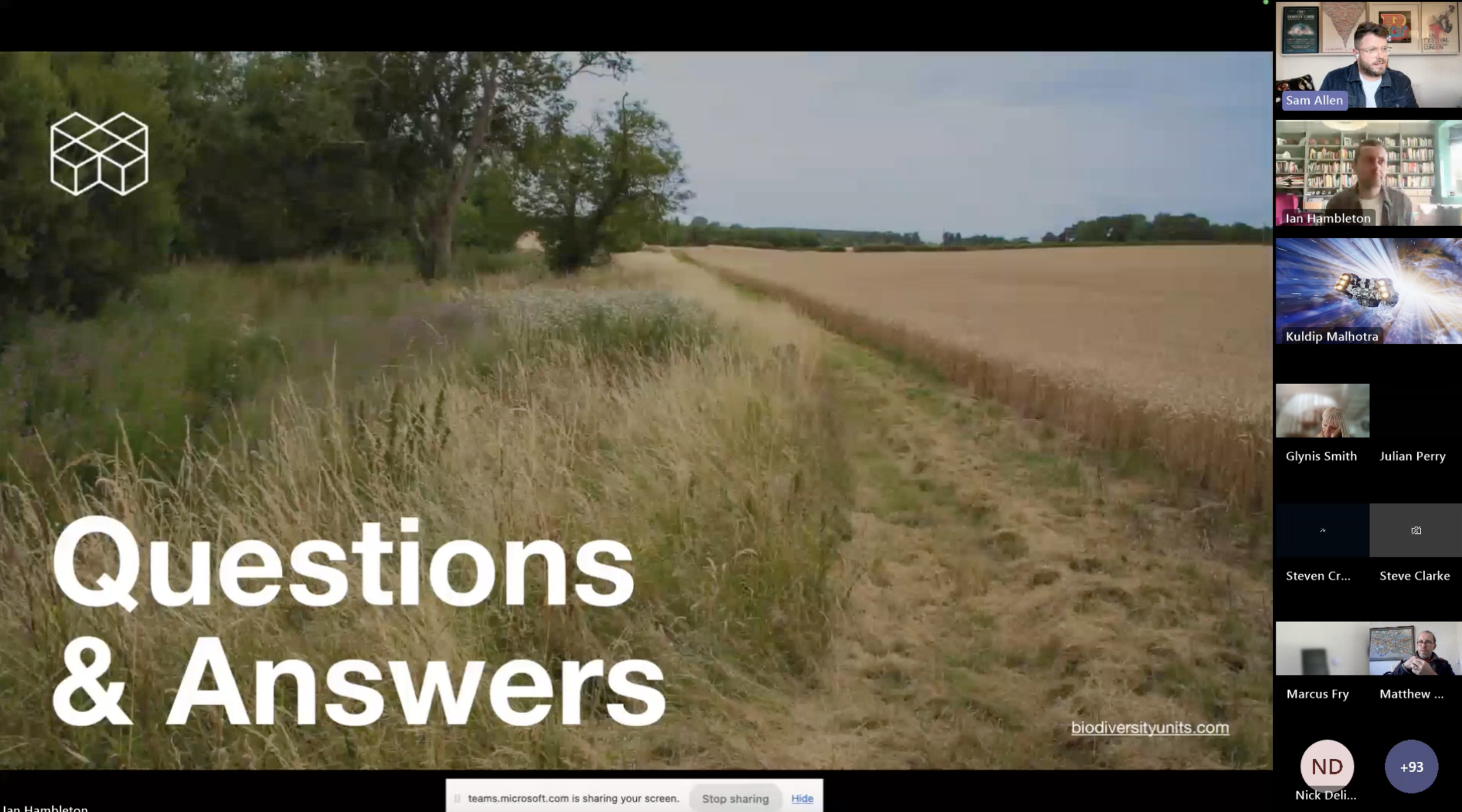
A screenshot from our Lunch & Learn seminar.
On March 25th we hosted our first "How to Buy BNG at the Right Price" Lunch & Learn, led by our founder, Ian Hambleton and Account Director, Sam Allen.
Over 120 people attended: developers, ecologists, architects, planning consultants, LPAs and habitat banks. The best part was the questions - which were incisive and wide ranging over 30 minutes.
Here are the standout Q&As, covering everything from BNG costs to supplier due diligence.
"When do I actually need to buy BNG units - and how much?"
This came from an architect who was completely new to BNG for developers and wanted the basics laid out clearly. It's a question we hear constantly, and it's worth answering properly.
As Ian explained, the number of offsite BNG units you need comes from the DEFRA biodiversity metric, which your ecologist produces after doing baseline assessments and mapping your development.
The amount varies hugely - a large brownfield site might have a tiny BNG requirement, while a small site with existing habitats could need a significant number of units.
Step one is always to look at what you can deliver on site. If that's not practical, or the numbers don't stack up, that's when you need to purchase BNG units on the offsite market.
Ian's advice was to use something like the BNG price calculator early in the design phase: "You can chuck those different metrics in and get a really quick price to be able to budget with" - rather than going out to habitat banks for formal quotes before the metric is even finalised.
"Am I buying land, or just the biodiversity improvement?"
A common source of confusion. Ian was clear on this: "As a developer, you are buying that improvement. You're not having to deliver that improvement yourself." The habitat bank creates the biodiversity gain over 30 years, and you're funding that uplift. The units are tracked through the Natural England register, which prevents double-counting and gives your LPA the evidence that the obligation has been met.
It's also worth noting that with the 10% net gain requirement, you're not just replacing what you're taking away. The metric builds in additional uplift, so the net effect is genuinely nature-positive.
"How do you evaluate a supplier's credibility? What are the red flags?"
This was the biggest theme of the session — multiple attendees asked versions of this question. It clearly matters to buyers, and rightly so.
Ian outlined BDU's approach: "We do due diligence on all the different suppliers, we look at the quality of what they're doing. We also give them a rating — some of that is based on their commitment to nature, some of it is around how good they are at communicating." Because at the end of the day, a habitat bank that doesn't respond when you need units allocated is a problem, regardless of how good their ecology is.
For developers doing their own due diligence on a BNG habitat bank, Ian suggested asking to see the conservation covenant or Section 106, and looking at the habitat management and monitoring plan (HMMP). One clear warning on BNG costs: "Be really suspicious of really low price units. If there's units that are significantly below the price of the market, you've got to ask a lot more questions about how they're being delivered."
"Do I need to pay a deposit before getting planning permission?"
A fair concern — nobody wants to put money down on BNG units and then fail at planning. Ian's answer was honest: it depends on your situation.
If you're dealing with a scarce habitat type where prices might shift, reserving early can make sense. But it's not always necessary. As Ian put it: "It doesn't always mean that you should be putting down a reservation before planning." Many developers go into planning having identified a supplier and provided supporting paperwork to the LPA, then formally reserve or purchase post-consent.
Reservations typically require a 10% deposit and hold units for six to twelve months, though the terms vary between habitat banks and can often be negotiated. Once you do complete the purchase, the supplier registers your units and you receive a biodiversity gain plan (BGP) — the document that ties everything together and allows your LPA to discharge the BNG condition.
"Could a well-funded developer buy up all the local BNG units?"
A sharp question about market risk. Ian's view was that it's theoretically possible but practically unlikely: "The further and further you rule down that thread, it becomes pretty impractical." The spatial risk multiplier means units are most useful locally, but they also need to match specific habitat types — so cornering a local market would require buying units you might not even need.
The broader point is that the offsite BNG market is now functioning well enough that supply and demand dynamics self-correct. Our pricing report — now covering 185 habitat banks — shows BNG unit prices stabilising across most habitat types, with good geographic coverage emerging across England's national character areas. For developers comparing BNG credits from different providers, the data is increasingly clear on what a fair price looks like.
"How will mandatory BNG for major infrastructure projects change the market?"
From May 2026, nationally significant infrastructure projects (NSIPs) will fall under mandatory BNG, and the implications are significant. Ian noted that some of the unit requirements coming through are substantial: "500 units, 1,200 units, really large unit requirements. Arguably that might completely shift the whole supply-demand part of the market."
The geographic impact could be just as important. Current BNG demand follows housing development patterns, but NSIPs could suddenly create high demand in areas where habitat banks have had low uptake — reshaping the market map entirely. However, many of these are long-term projects delivered over 5 to 15 years, so the buying patterns will likely look very different from standard development.
What's next
We're running these sessions monthly.
Whether you need to buy biodiversity net gain units for the first time or you've done it before and want a better deal, the next lunch and learn is open for registration.
And if you've got a live project and want to understand your BNG options, get in touch.
That's what we're here for.
Register for the next How to Buy BNG lunch and learn → click here
Use the BNG Price Calculator to estimate your BNG costs → click here
Download the latest BNG Pricing Report — free → click here
Or watch the full Q&A below: